Thermal Imaging

Thermal Imaging

Thermal Imaging at CVAIL combines learning-based perception with physically informed reasoning so models can operate under real-world constraints instead of idealized settings. We study thermal perception pipelines for detection, representation learning, and cross-modal reasoning in conditions where standard RGB sensing breaks down.

Publications

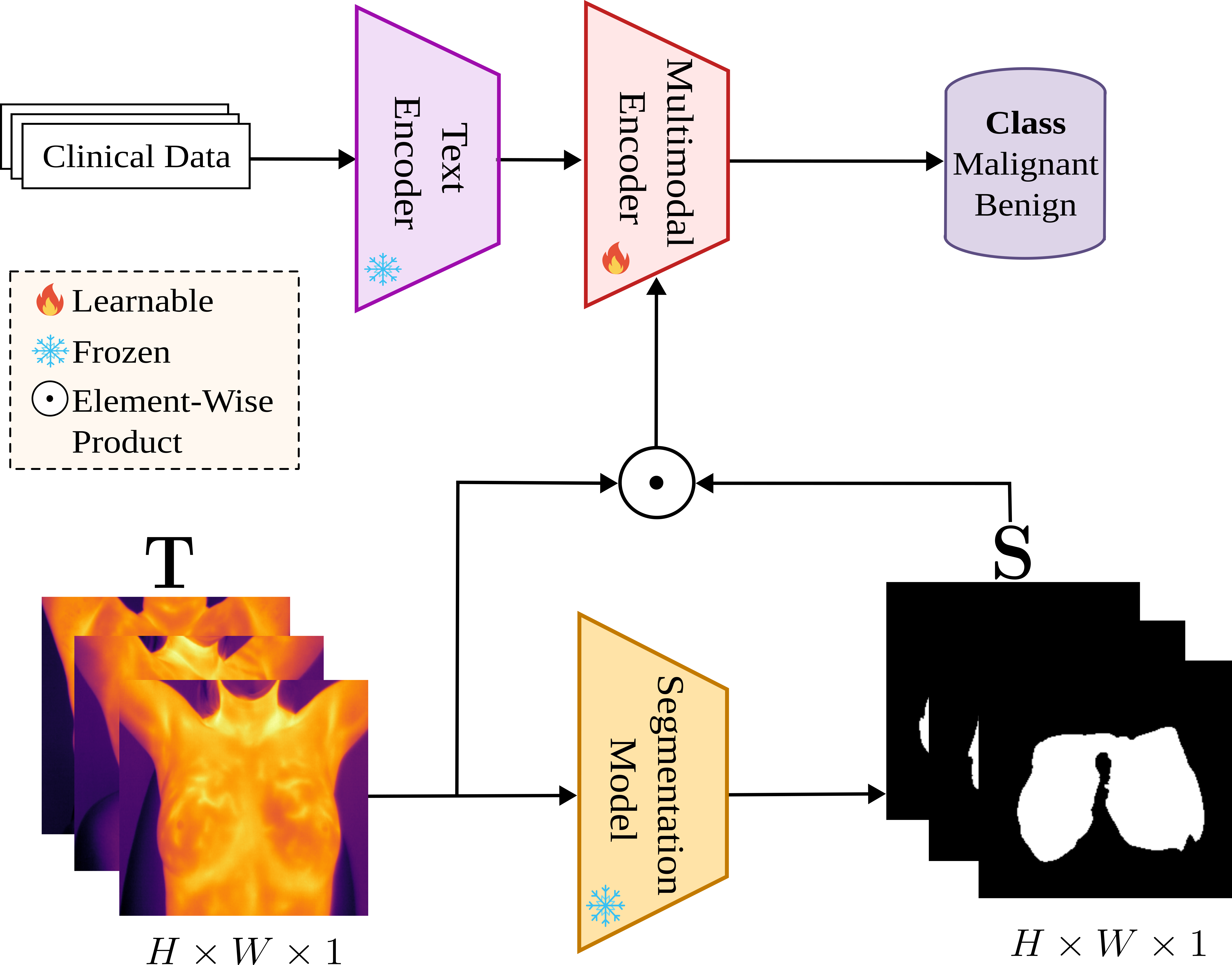
Multimodal Vision-Language Transformer for Thermography Breast Cancer Classification

Abstract

This multimodal vision-language transformer classifies breast cancer from a single thermal image by fusing thermal features with structured clinical metadata encoded as text prompts. Cross-attention blocks combine patient-specific cues with image tokens, enabling robust predictions across different viewpoints. Experiments on the DMR-IR and Breast Thermography datasets show strong accuracy and sensitivity, outperforming visual-only and prior multimodal baselines.

ColCACI

2025
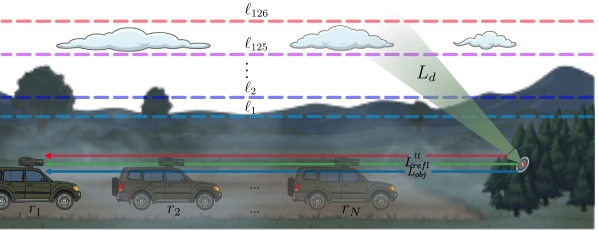
Set-Based Transformer for Atmospheric Compensation in Standoff LWIR Hyperspectral Imaging

Abstract

Passive long-wave infrared (LWIR) hyperspectral imaging under a standoff geometry depends on atmospheric absorption and emission, as well as reflected radiance, thus making atmospheric compensation essential to get knowledge of a target of interest. Despite its importance, this compensation has been largely overlooked due to its practical and modeling difficulty. In this paper, we present a lightweight set-based deep learning framework that takes multiple radiance measurements, collected at different standoff ranges, as input and jointly estimates transmittance, atmospheric path radiance, and a shared downwelling spectrum. We analyze the learned representation with a sparse autoencoder and observe that several latent features do activate on geographically coherent subsets of the test data despite the absence of location supervision. Experiments on a MODTRAN generated standoff LWIR dataset demonstrate low spectral distortion across all estimated products.

IGARSS

2026
Back to Research
© 2026 CVAIL. All Rights Reserved
Policies and Terms
Powered by CVAIL Research Group